
Why are UK prices still rising?

Prices in the UK rose by 3% in the year to February, holding steady from the 3% recorded in January.
The figures from the Office for National Statistics (ONS) were collected before the start of the US-Israel war with Iran, which is expected to speed up the pace of price rises.
It means that inflation still remains above the Bank of England's 2% target.
The Bank moves interest rates up and down to try to keep inflation on track. Six cuts since August 2024 have brought rates down to 3.75%.
What is inflation?
Inflation is the increase in the price of something over time.
For example, if a bottle of milk costs £1 but is £1.05 a year later, then annual milk inflation is 5%.
How is the UK's inflation rate measured?
The prices of hundreds of everyday items, including food and fuel, are tracked by the ONS.
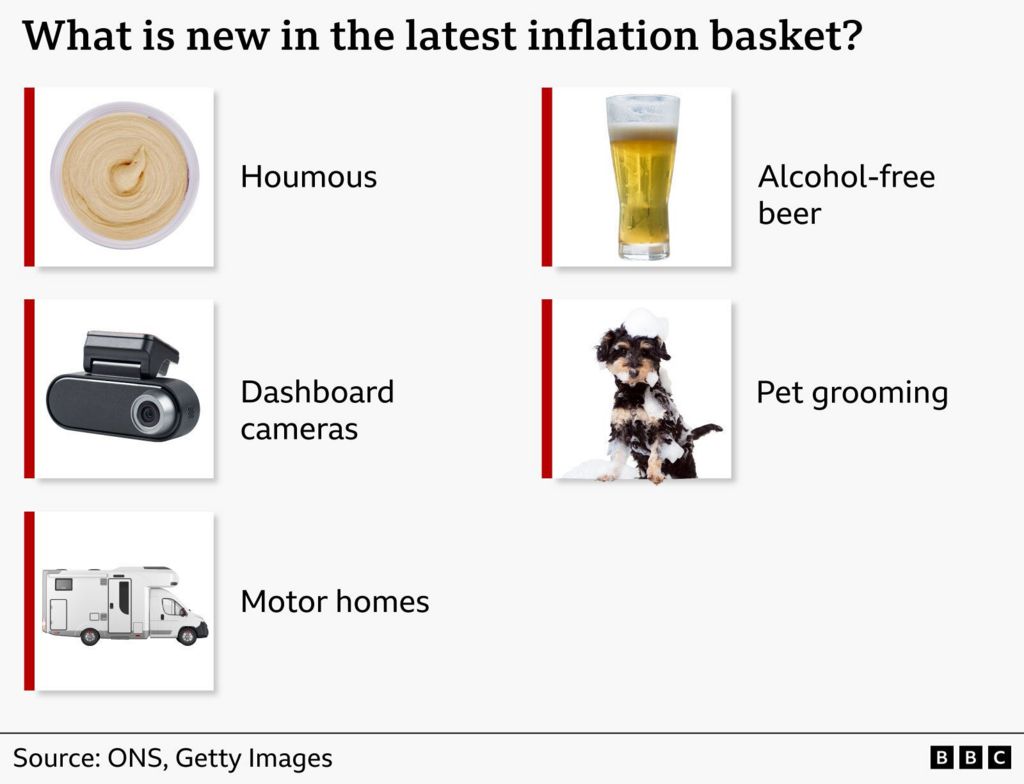
This virtual "basket of goods" is regularly updated to reflect shopping trends, with alcohol-free beer, dashboard cameras, and pet grooming equipment among items added in 2026, while premium bottled lager, some categories of wine and sheets of wrapping paper were removed.
The ONS monitors price changes over the previous 12 months to calculate inflation.
The main inflation measure is called the Consumer Prices Index (CPI), and the latest figure is published every month.
What is happening to UK inflation?
Although the February CPI figure of 3% remains above the Bank of England's target, it is well below the 11.1% figure reached in October 2022.
That was the highest rate for 40 years.
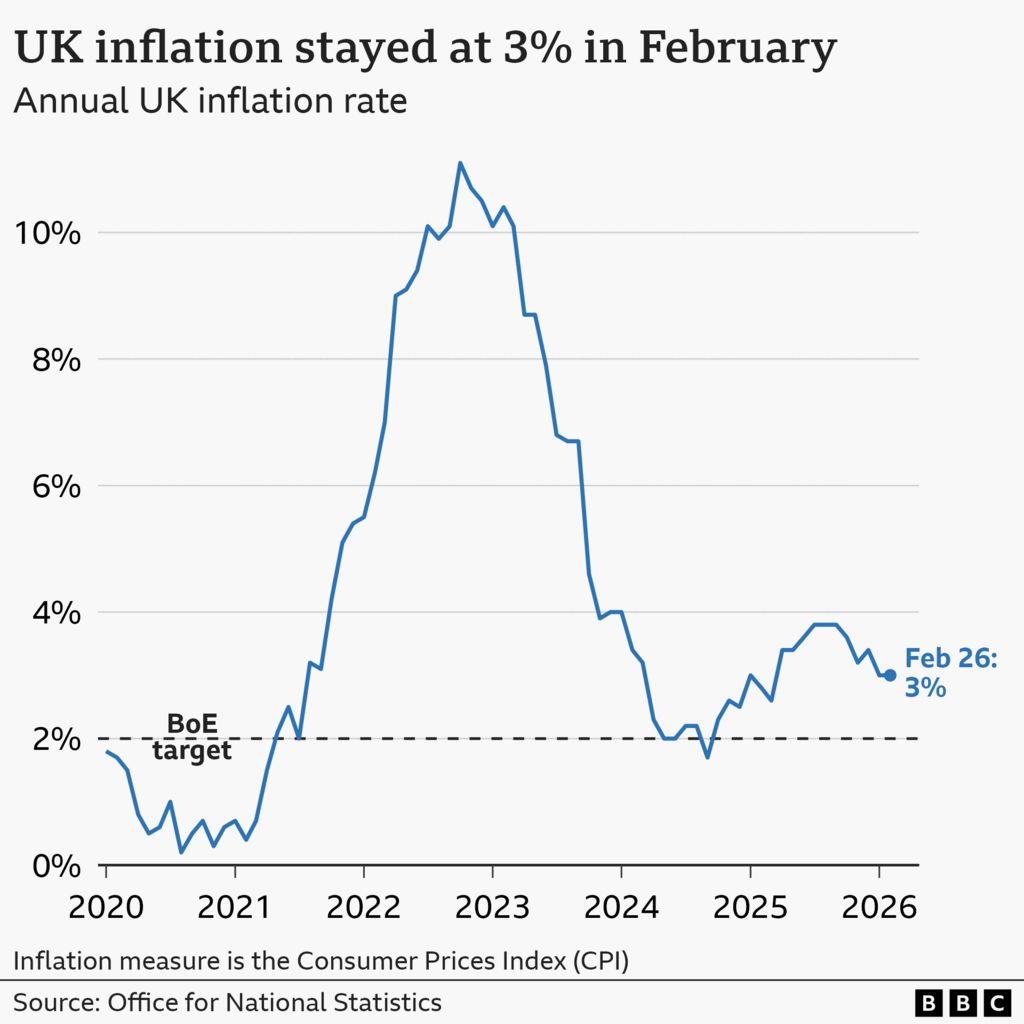
Inflation holding at 3%, showing that prices are still rising at a steady rate, was in line with what most economists had predicted.
Clothing and footwear contributed to price rises and was offset by lower fuel prices, but the CPI figure for February does not reflect the Iran war, which is predicted to push fuel prices up.
Partly because food or energy prices can be very volatile, the Bank of England also considers other measures, such as "core inflation", when deciding whether and how to change rates.
By stripping out food or energy costs, the core measure can be a better indication of longer-term trends.
Core CPI was 3.2% in the 12 months to February, rising from 3.1% in January, which had been the lowest level since September 2021.
UK inflation is expected to be at or around the target level of 2% over the next five years, according to the official forecasts published alongside Chancellor Rachel Reeves' Spring Statement on 3 March, but those predictions were made before the Iran war.
Why are prices still rising?
Although inflation has fallen significantly since the October 2022 high, that doesn't mean prices are falling — just that they are rising less quickly.
Inflation soared in 2022 because oil and gas were in greater demand after the Covid pandemic, and energy prices surged again when Russia invaded Ukraine.
It then remained well above the 2% target, partly because of higher food prices.
Food price inflation has continued to be an issue, but the data for January suggests food prices are rising at their slowest rate since April last year.
Employees facing higher living costs are then more likely to push for higher wages and salaries. This, as well as higher staffing costs through employer National Insurance contributions and minimum wage hikes, means companies will be under pressure to pass higher costs onto customers through higher prices.
Why does putting up interest rates help to lower inflation?
When inflation was well above its 2% target, the Bank of England increased interest rates to 5.25%, a 16-year high.
The idea is to make borrowing more expensive, meaning people and businesses have less money to spend. People may also be encouraged to save more.
In turn, this reduces demand for goods and slows price rises.
But it is a balancing act - increasing borrowing costs risks harming the economy.
For example, homeowners face higher mortgage repayments, which can outweigh better savings deals.
Businesses also borrow less, making them less likely to create jobs. Some may cut staff and reduce investment.
In recent months, inflation has remained above the Bank's target at the same time as the economy has remained relatively flat and the jobs market has softened.
Therefore, the Bank has chosen to cut rates, despite high inflation, in an attempt to encourage people to spend more and get businesses to invest and create jobs to boost the economy.
What is happening to UK interest rates and when will they go down again?
The Bank of England began cutting rates in August 2024.
Six cuts since then have brought rates down to 3.75%, the lowest level since early 2023.
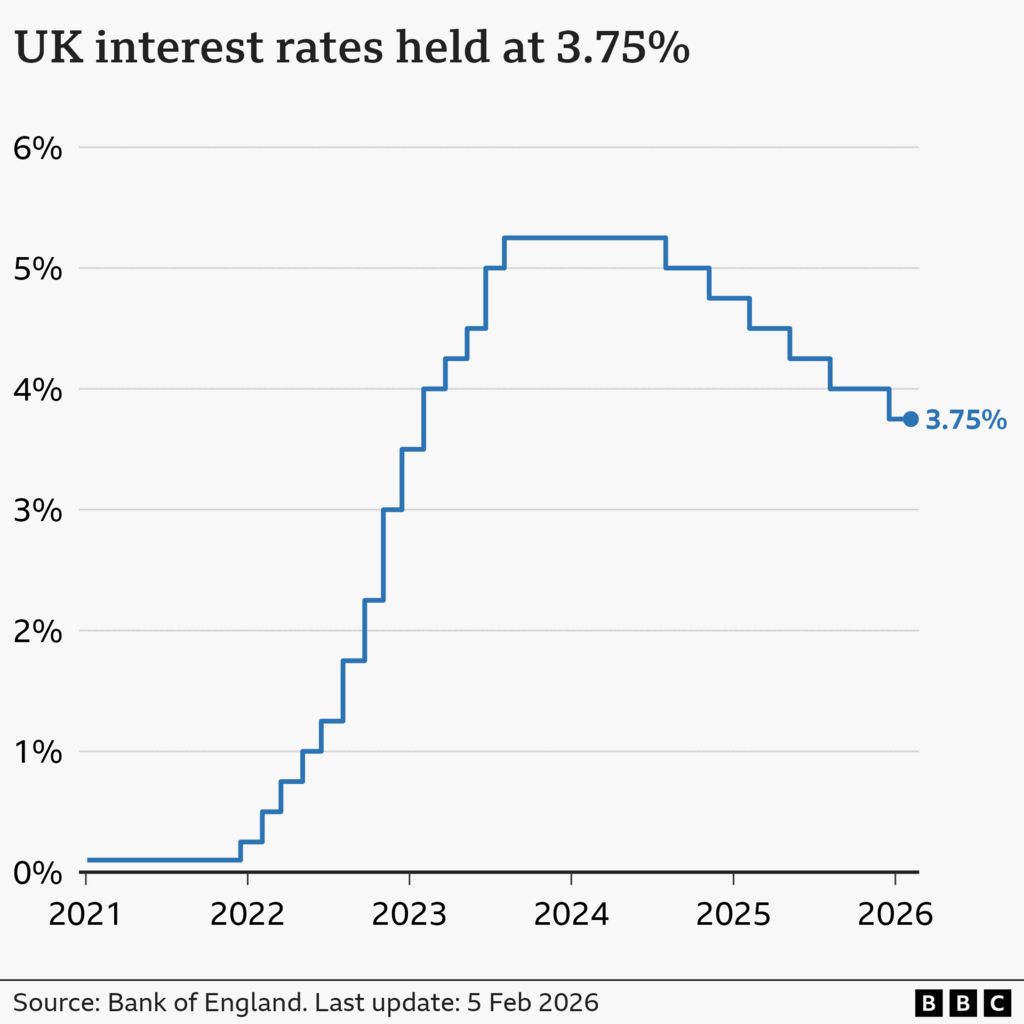
The most recent cut in December 2025 reflected concerns over rising unemployment and weak economic growth. However, it was tight vote, with policymakers voting 5-4 in favour of a cut.
The vote was equally tight in February, when policymakers decided to keep rates at 3.75%.
After the February announcement, Bank governor Andrew Bailey said he expected inflation to be close to the Bank's 2% target from spring onwards, adding there could be "scope" for some further rate cuts this year.
However, this was before the Iran war. Before it started, analysts had predicted a cut in the Bank rate at the March meeting, but the conflict led to a change in expectations.
In the end, the Bank's monetary policy committee voted unanimously to keep rates at 3.75%.
The Bank said prices would rise more quickly as a result of the conflict, and it now expects inflation to be close to 3.5% when the March figures are released.
Are wages keeping up with inflation?
The latest official figures show that regular pay in the UK grew by slightly more than inflation between November and January.
Average annual growth in pay (excluding bonuses) during the three-month period fell to 3.8%, down from 4.2% recorded between between October and December. That was the lowest growth recorded in more than five years.
After taking inflation into account, it means wages grew by 0.5% for regular pay between November and January 2026.
Annual average earnings growth for the quarter was 5.9% for the public sector and 3.3% for the private sector.
Meanwhile, separate ONS figures showed the estimated number of job vacancies in the UK fell by 6,000 to 721,000 between December and February.
The unemployment rate was 5.2% in the three months to January, up from the rate in the previous quarter and above estimates from a year ago. That will also factor into the Bank's interest rate calculations.
Early estimates suggest the number of job vacancies dropped by 6,000 to 721,000 in the three months to February.
The number of payrolled employees recorded in February rose by about 20,000 from the previous month, to 30.3 million.
What is happening to inflation and interest rates in Europe and the US?
The US and eurozone countries have also been trying to limit price increases, but both have lower central bank interest rates than the UK.
The inflation rate for countries using the euro was 1.9% in February, according to EU data — up from 1.7% in January.
Between June 2024 and June 2025, the European Central Bank (ECB) cut its main interest rate from an all-time high of 4% to 2%, where it has remained.
In the US, price increases have eased in recent months. Prices rose by 2.4% over the 12 months to February, the Department of Labor said. That was the same as the prior month which had marked the slowest pace since May.
In March, the US Federal Reserve held its target interest rate at a range of 3.50% to 3.75% — its lowest level in three years.
Earlier in the year, the Fed had come under attack from US President Donald Trump for not cutting rates.
Trump has picked Kevin Warsh to lead the Fed when current chairman Jerome Powell's four-year term ends in May.
(Feed generated with FetchRSS)