
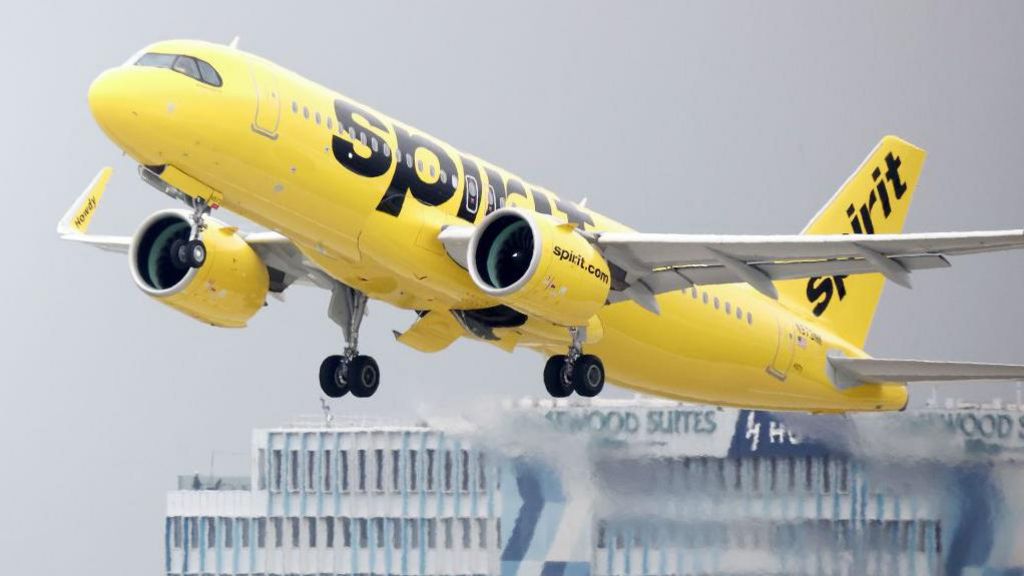
Spirit Airlines is shutting down as a business after failing to secure a $500m (£368m) bailout from the Trump administration.
The budget airline was in talks with the US government about a rescue deal which would have saved it from going out of business.
But discussions collapsed and the carrier said in an announcement on its website on Saturday that with "great disappointment" it had "started an orderly wind-down of our operations, effective immediately". That included canceling flights across the US.
Spirit was emerging from its second bankruptcy filing in recent years before the US-Israel war in Iran, but the resulting surge in jet fuel costs pushed it over the brink.
"All Spirit flights have been cancelled, and Spirit Guests should not go to the airport," the company said in its statement posted early Saturday morning.
The airline also said it would automatically process refunds for any flights purchased through Spirit with a credit or debit card to the original form of payment.
Guests who booked flights via a travel agent should contact the travel agent directly to request a refund.
Compensation for those who booked flights using a voucher, credit, airline points or any other method will be determined at a later date through the bankruptcy court process.
The airline said it was unfortunately not able to reimburse guests for other related costs such as emergency hotel stays or replacement flights associated with cancelled trips.
Spirit's customer service is no longer available, the airline said early on Saturday, but customers with questions can contact the carrier's claims agent.
In the statement, Spirit's CEO Dave Davis said: "In March 2026, we reached an agreement with our bondholders on a restructuring plan that would have allowed us to emerge as a go-forward business.
"However, the sudden and sustained rise in fuel prices in recent weeks ultimately has left us with no alternative but to pursue an orderly wind-down of the company."
But Transportation Secretary Sean Duffy said on Saturday that Spirit's demise was not the result of fuel price increases, which are largely due to the war with Iran.
"Spirit was in dire straits long before the war with Iran," Duffy said, citing the company's multiple bankruptcy filings, in a news conference at Newark Liberty International Airport.
"Their model wasn't working," he added. "The war was not the impetus."
The airline's demise was so abrupt that it has left many ticketholders in the lurch.
One Spirit customer, Yash Kothari, told the BBC's US partner CBS News that he didn't learn about the airline's shutdown until he arrived at Philadelphia International Airport for a flight at 05:45 local time (09:45 GMT) on Saturday.
"The email came in at 1 am, so I was unaware," Kothari told the outlet.
Other US airlines — including Delta Airlines, United Airlines, American Airlines and Frontier Airlines — have stepped in to offer "rescue fares" to stranded Spirit customers. The fares vary by airline, with Delta offering reduced, nonrefundable fares for the next five days, while United is offering price-capped one-way tickets for the next two weeks.
Fuel costs can make up as much as 40% of an airline's outgoings, and airlines have seen the cost of jet fuel double since the US and Israeli strikes began at the end of February.
Savanthi Syth, airlines analyst at the investment bank Raymond James, said spiralling jet fuel costs in the wake of the Iran war had proved "the final nail in the coffin" for Spirit.
Speaking to the BBC, Syth said the operator had shied away from the radical overhaul it needed during a 2024 bankruptcy procedure.
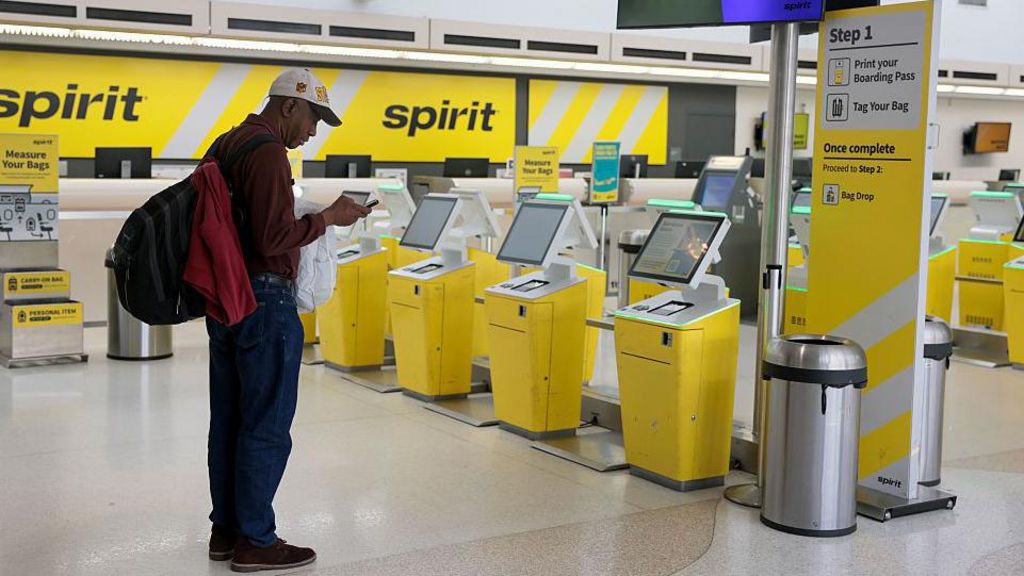
Spirit had been in the process of making the changes it needed in its current bankruptcy process, scaling back the number of flights it was offering and aircraft it owned, she said.
But its ability to survive the year was in question even before the Iran war, Syth added.
"If it wasn't for the fuel scenario, they would have been okay through the summer, beyond the summer I would have said it was still precarious."
The International Association of Machinists and Aerospace Workers (IAM) union, which represents Spirit staff, said the news was "devastating for the thousands of airline workers who showed up every day and gave everything to keep Spirit Airlines in the air".
"Our members on the ramp did not cause this failure; corporate mismanagement and poor financial stewardship did," the IAM union continued in a statement. "Our members deserve answers and support."
The IAM union said it would be providing additional support to its members affected by Spirit's shutdown and urged the airline's leadership and the bankruptcy court "to ensure that every worker receives the full severance, back pay, and benefits they are owed".
Some airlines have been cutting flights and others have hiked fares to cope with the cost increases. At the same time, the head of the International Energy Agency (IEA) has warned Europe could run out of jet fuel in as little as six weeks.
At the end of April, Spirit had been confident its rescue deal with the Trump administration was to be finalised imminently.
But after that deal fell through, Trump on Friday told BBC partner CBS the airline had been offered "a final proposal" to keep it in business.
The earlier plan, which would have seen the US government take effective ownership of as much as 90% of the airline, faced stiff opposition from Wall Street, Capitol Hill and even a member of Trump's own cabinet. Transportation Secretary Sean Duffy told Reuters a rescue would amount to tossing "good money after bad".
Correction 02/05/2026: An earlier version of this story incorrectly stated the refund process for cancelled Spirit flights.
(Feed generated with FetchRSS)